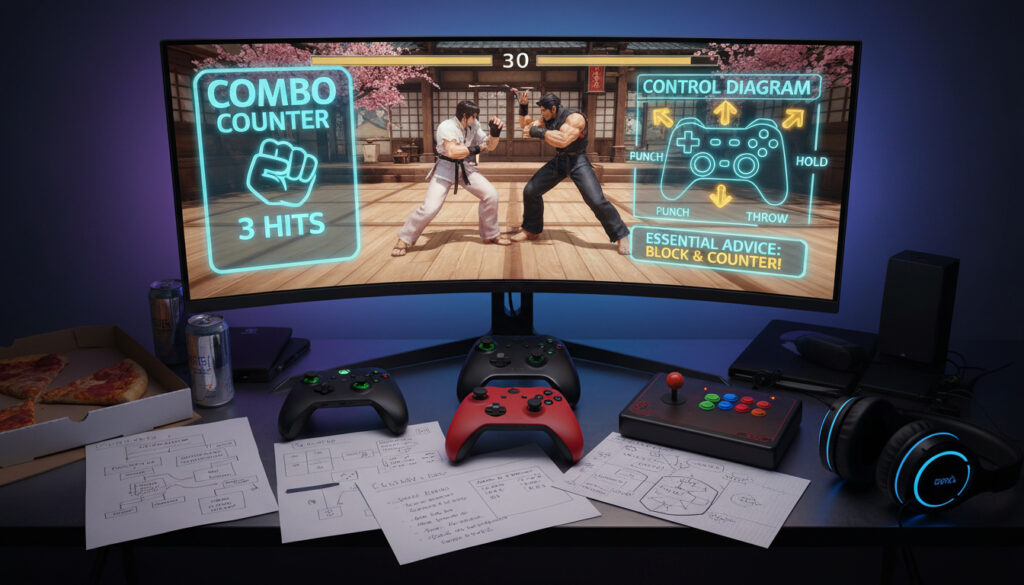
Dead or Alive 6 – Bästa Tipsen för Nybörjare
Introduction
Dead or Alive 6 arrived on March 1, 2019, marking Team Ninja’s deliberate attempt to reposition the franchise within the competitive fighting game community. Departing from the marketing strategies of previous entries, the development team emphasized mechanical depth and tournament viability over the cheesecake photography that had defined earlier promotional cycles. Built upon a heavily modified iteration of the engine powering Dead or Alive 5: Last Round, the release introduced the Break Gauge system—a four-bar meter enabling Fatal Rush combos and Break Holds that fundamentally altered the tempo of exchanges. Despite these competitive aspirations, the title launched into a marketplace already dominated by established heavyweight fighters, forcing it to justify its existence through distinct mechanical identity rather than spectacle alone.
Foundation and Mechanics
Fatal Rush and Break Gauge
The most significant mechanical addition, the Break Gauge, fills as fighters exchange blows, unlocking Fatal Rush—a four-hit auto-combo concluding with a Break Blow cinematic attack. This system provides comeback potential while demanding meter management that previous entries lacked.
Triangle System Refinement
Dead or Alive 6 preserves the rock-paper-scissors foundation of strikes, holds, and throws, though hold timing windows tightened significantly to reduce spam vulnerability. Damage scaling adjustments prevented infinite combos while maintaining the series’ hallmark juggle potential.
Mass-Key Interactions
Multi-tiered arenas return with expanded danger zone triggers, allowing fighters to smash opponents through barriers, off ledges, or into explosive environmental hazards that extend combo opportunities. The PC version particularly shines here, rendering particle effects during stage transitions at higher fidelity than console counterparts.
New Blood
Diego, a street brawler from New York, and NiCO, a scientific prodigy employing electromagnetic combat theory, joined the roster alongside returning veterans, each bringing distinct timing requirements to the triangle system.
Market Position and Monetization
The release strategy generated significant discourse regarding accessibility and content gating. Team Ninja adopted a free-to-play Core Fighters model alongside the full retail release, offering a rotating selection of free characters while locking story mode and training features behind the premium purchase. This approach attracted casual players but fragmented the online player base during critical launch weeks.
Costume unlock rates became a point of contention, with the grinding requirements for individual outfits substantially higher than in Dead or Alive 5. The developer subsequently adjusted earn rates through patches, though the damage to early player retention had already occurred. Additionally, the Season Pass pricing—exceeding the cost of the base game—drew criticism for obscuring individual DLC purchasing options within the storefront interface. Critics noted that this aggressive monetization undermined the game’s accessibility goals.
Technical Specifications
| Platform | Resolution | Frame Rate | Netcode Type | Input Lag |
|---|---|---|---|---|
| PlayStation 4 | 1080p | 60fps (variable) | Delay-based | 4.2 frames |
| Xbox One X | 4K (dynamic) | 60fps (locked) | Delay-based | 3.8 frames |
| PC | 4K+ | 60fps+ | Delay-based | 2.1-3.5 frames |
| PlayStation 5* | 4K (backwards compat) | 60fps (locked) | Delay-based | ~3.0 frames |
*Via backwards compatibility; no native next-gen patch released.
Implementation Details
The PC port demonstrated substantial technical competence, offering uncapped frame rates and 4K resolution support that exceeded console capabilities. However, netcode implementation utilized delay-based rather than rollback technology, creating noticeable input latency during transcontinental matches. The tutorial system, while comprehensive in explaining basic mechanics, lacked frame data display within training mode—a critical omission for serious competitors who relied on community resources for precise timing information.
Character models received substantial geometric upgrades, with fabric physics and muscle deformation systems producing more realistic impacts. These visual improvements demanded significant GPU resources, causing performance dips on base-model PlayStation 4 hardware during particle-heavy Break Blow sequences. Team Ninja’s engine optimization prioritized visual fidelity over hardware scalability, impacting the experience on launch-era consoles.
Development Timeline
Development announcements began , with Team Ninja revealing the title through a cinematic trailer emphasizing “intense fighting entertainment” rather than the beach volleyball spin-off aesthetics that had previously distracted from the main series. The beta period ran , collecting telemetry data that prompted day-one balance adjustments to character weight classes.
Post-launch support extended through , concluding with the addition of Kasumi’s “La Mariposa” costume and the final balance patch addressing competitive tier list disparities. In , Team Ninja announced cessation of additional content development, ending tournament support and pivoting resources toward next-generation projects. The servers remain operational, though tournament prize pools diminished rapidly following the end of official backing.
Clarifying the Design Philosophy
Addressing the tension between competing interests requires acknowledging the friction between Team Ninja’s stated esports ambitions and the series’ historical identity. Lead director Yohei Shimbori initially suggested that costume damage and breast physics would tone down for international appeal, yet launch day featured purchasable “brightly-colored” outfits and jiggle physics toggle options. This contradiction generated skepticism among both competitive players, who feared the game would not be taken seriously by tournament organizers, and longtime fans who felt the
関連記事をさらに表示
 神木隆之介の結婚相手は?噂の真相と現在の活動
 ドレス選び完全ガイド:パーティー・結婚式・レンタル
 ポークソテー ソース 醤油 人気 – 和風バターソースの黄金比とレシピランキング
 紀子様(文仁親王妃紀子)のプロフィール、バッシング理由、年齢・経歴やなぜ人気ないのかを詳細に徹底解説
 LOVE GOOD TIME 歌詞 全文 – SpecialThank オオカミ少女と黒王子 OP
 田島麻衣子(立憲民主党現役参議院議員・元国連WFP職員)の経歴・学歴・家族構成・現在の活動を徹底解説
 だしとは?和風スープの基本から山形郷土料理の「だし」まで、意味・作り方・語源・うま味の科学を完全解説
 【完全版】GENERATIONS小森隼のプロフィール徹底解説!国籍・学歴・彼女・家族・現在の活動まで
